Who Vynix is for, and what it fixes
Most website bug reports lose important details between the person who spots the problem and the person who fixes it. Vynix is built for that gap: click the broken part of a site, capture the context around it, and turn the report into something a developer or coding agent can act on.
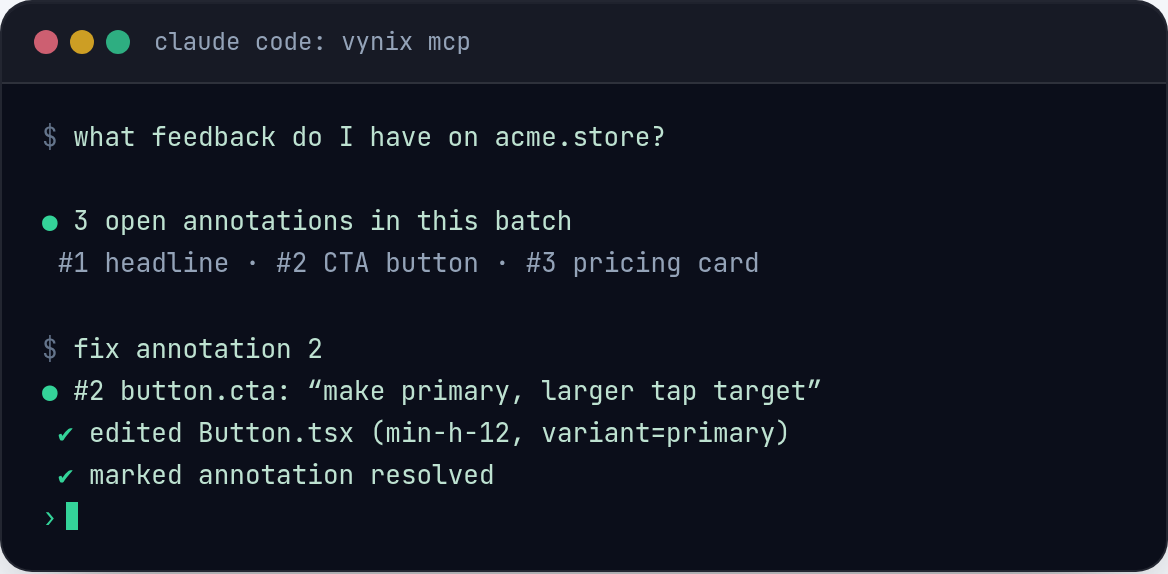
- The basic problem: bug reports are usually missing the useful parts
- For founders and product leads who inspect the site every day
- For developers who need reproducible context, not detective work
- For QA testers and support teams who already see the patterns
- For teams using AI coding agents
- When Vynix is the right fit, and when it is not
The basic problem: bug reports are usually missing the useful parts
A website issue often starts with a message like, "The checkout button is broken" or "The page looks weird on my screen." That might be true, but it does not tell the developer which element was clicked, what the page looked like at the time, whether the browser console had an error, or whether an API request failed in the background.
The next step is usually a slow back-and-forth. Someone asks for a screenshot. Someone else asks which browser they used. A developer tries to reproduce it locally and cannot. The issue sits in a tracker with a vague title while the real context disappears.
Vynix is for teams that want to cut out that translation problem. It lets someone click directly on what is wrong, then captures the selected element, a screenshot, console context, network context, and an AI diagnosis of the likely root cause. Instead of turning a visual problem into a vague sentence, it turns it into a developer-ready report.
- No need to explain which button, form field, image, or section is broken.
- No need to manually gather console errors or failed network calls.
- No need to rewrite the same bug report into a prompt or GitHub issue later.
For founders and product leads who inspect the site every day
Founders, product managers, and non-technical team members are often the first people to notice that something feels off. A landing page section wraps badly on mobile. A pricing card has the wrong spacing. A form accepts an invalid value. A dashboard widget appears empty after a deployment.
The problem is not spotting the issue. The problem is handing it to engineering without losing the details. Product people usually do not want to open DevTools, copy request data, inspect DOM nodes, or guess whether the bug belongs in frontend, backend, or data logic. They want to point at the problem and move on.
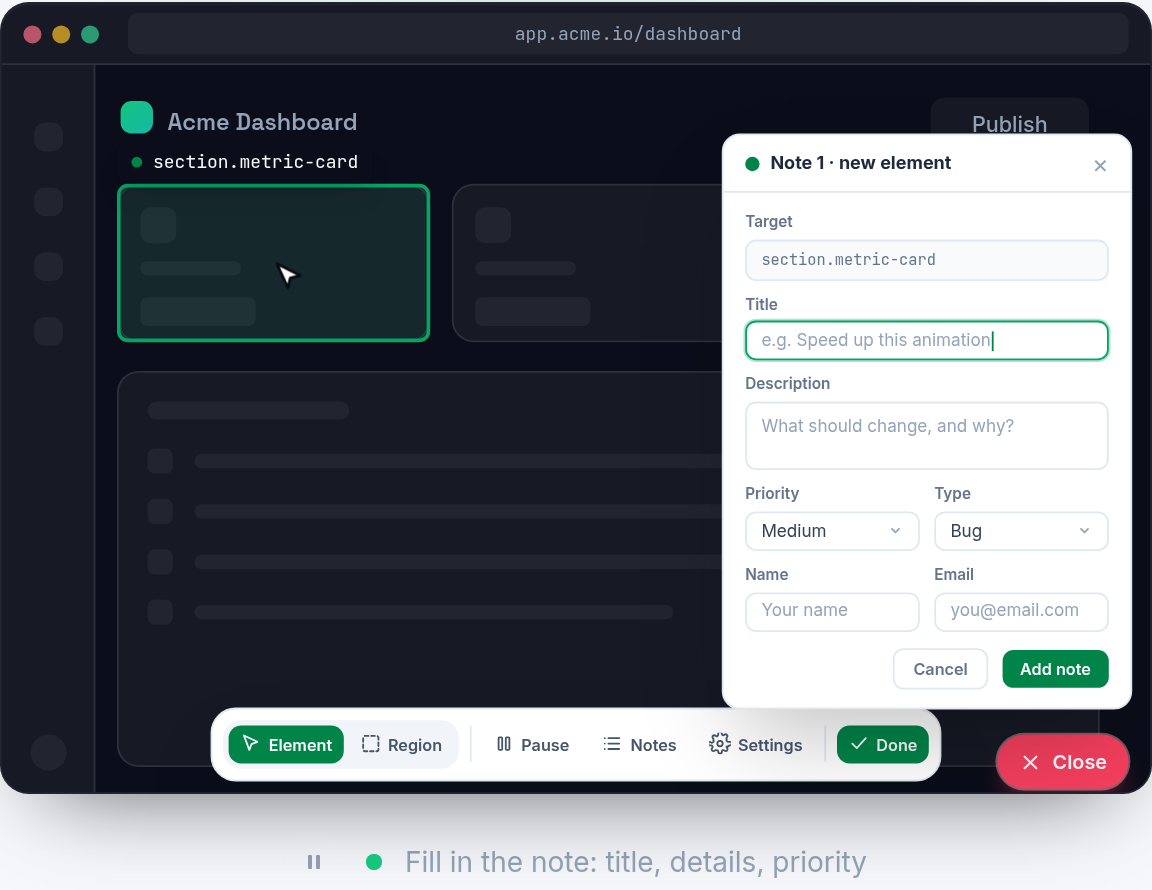
Vynix gives that workflow a cleaner shape. A product lead can drop the widget on a site, click the incorrect part of the page, and capture the surrounding technical evidence. The resulting report is not just "this looks wrong." It includes the element and page state, plus supporting console and network context that a developer can use.
This is useful for small teams where one person wears several hats. It is also useful when a founder is reviewing a staging site late at night and wants to create a useful issue without interrupting a developer in chat.
- Report a UI bug without knowing the component name.
- Preserve what the page looked like at the time of review.
- Give engineering enough context to start investigating without another meeting.
- Create a ready-to-build prompt when the next step is to hand the issue to an AI coding tool.
For developers who need reproducible context, not detective work
Developers do not need longer bug reports. They need better ones. A long description can still be useless if it leaves out the failing request, the browser-side error, or the exact element that triggered the behavior.
Vynix helps by collecting context at the point of failure. If a user clicks a broken button, the selected element matters. If a page shows stale data, the network context may matter. If a component fails to render, the console context may point to the cause. A screenshot gives the visual result, while the captured context gives the developer a path into the code.
The AI diagnosis is also helpful when used the right way. It should not be treated as a final verdict, but it can help frame the likely root cause. For example, it might suggest that a failed API call is causing an empty state, or that a JavaScript error is stopping a component from mounting. That is often enough to help a developer choose where to look first.
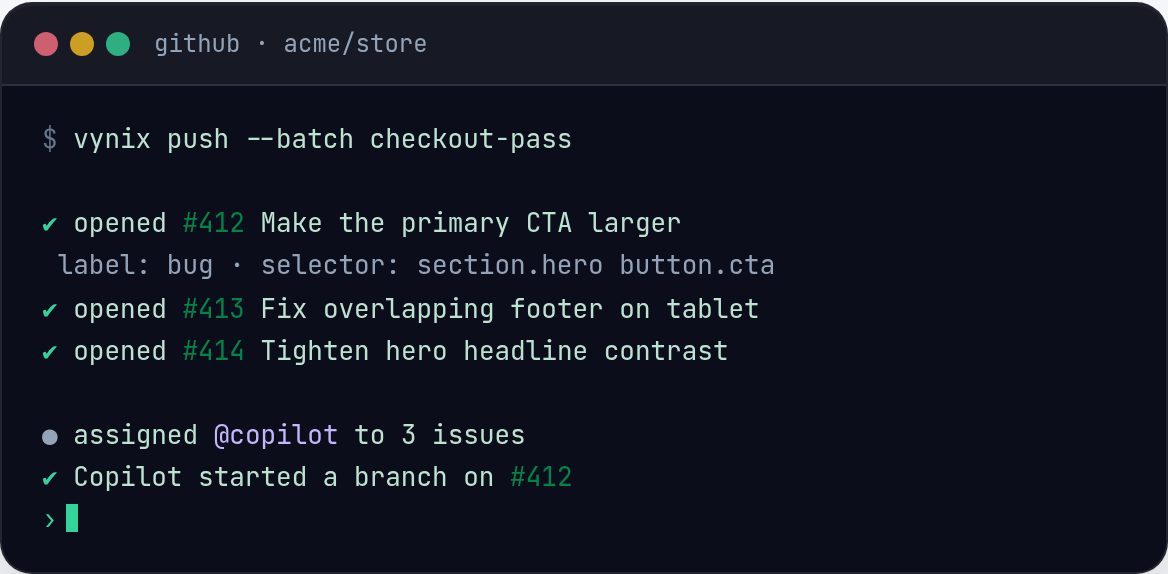
From there, the report can become a ready-to-build prompt or a GitHub issue. That matters because developers often lose time reformatting raw feedback into the shape required by their tools. Vynix reduces that handoff work.
- Element context helps connect the report to the UI component involved.
- Screenshot context shows the visible failure, not just the written complaint.
- Console context can reveal runtime errors near the moment of failure.
- Network context can show failed or suspicious requests.
- An AI diagnosis can suggest a likely starting point for investigation.
For QA testers and support teams who already see the patterns
QA testers and support teams are good at noticing repeat issues. They hear the same complaint from several users, or they find the same edge case during regression testing. The hard part is turning that pattern into an issue that engineering can pick up quickly.
A support message might include a user quote and a rough description. A QA note might include steps to reproduce. Both are useful, but they can still miss the runtime details. If an API request fails only in a certain state, or a component throws an error only after a specific interaction, the captured context can save time.
Vynix fits into this work because it does not ask QA or support to become developers. They can annotate the site directly, capture the evidence, and send the issue into the next tool. If the team uses GitHub issues, Vynix can open one. If the team uses AI coding agents, the captured report can be copied as a prompt and assigned for implementation.
This is especially useful for bugs found on staging, preview deployments, internal tools, or customer-facing pages where the site itself is the easiest place to explain the issue. The closer the report is to the actual broken UI, the less interpretation is required.
- QA can capture visual and technical context during test passes.
- Support can turn user-facing issues into clearer engineering tickets.
- Repeated bugs can be documented with the same kind of evidence each time.
- Teams can avoid screenshots in chat that are disconnected from technical data.
For teams using AI coding agents
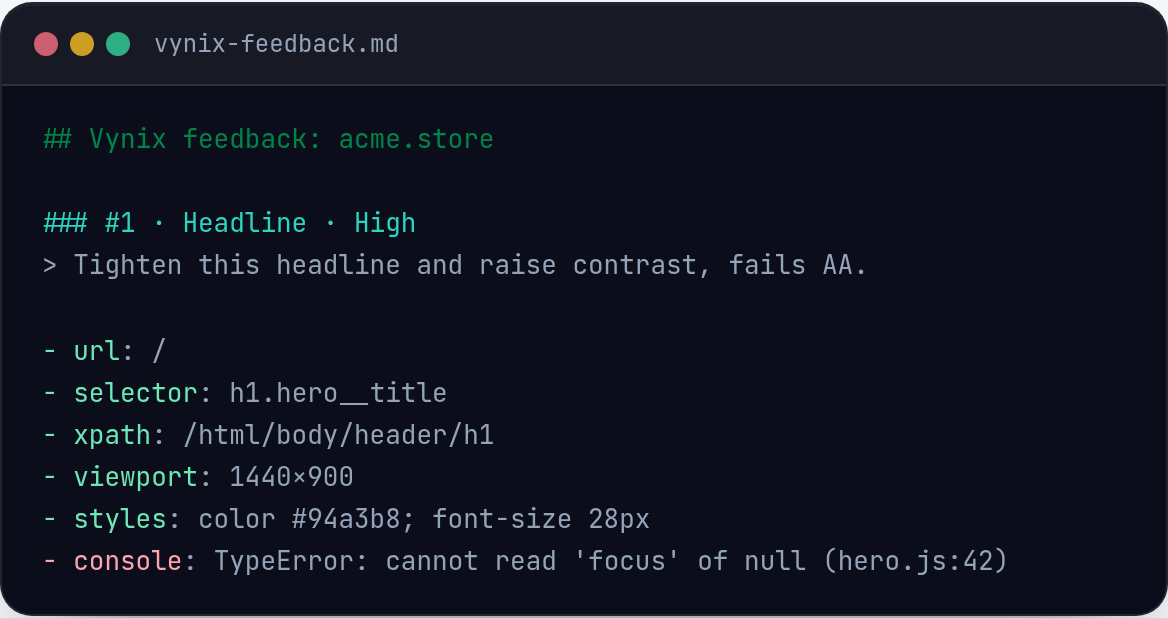
AI coding agents work best when the task is specific, grounded, and tied to real evidence. A vague prompt like "fix the settings page" can send an agent in the wrong direction. A better prompt says which element is broken, what the visible symptom is, what errors appeared, which requests were involved, and what outcome is expected.
Vynix is useful here because it gathers the kind of context that makes an agent task less ambiguous. The selected element and screenshot describe the UI failure. The console and network context can point toward the cause. The AI diagnosis can help summarize the likely problem. Then the report can be copied as a ready-to-build prompt or opened as a GitHub issue and assigned to a coding agent.
This does not remove the need for review. A developer still needs to check the change, read the diff, and make sure the fix matches the product behavior. But Vynix can improve the input given to the agent, which is often the difference between a useful first patch and a confused one.
A practical example: a user clicks "Save" on a profile form and nothing happens. With a plain prompt, the agent may search broadly across the form. With Vynix context, the prompt can include the selected button, the screenshot, a console error if one occurred, and network context showing whether the save request fired or failed. That is a much better starting point.
When Vynix is the right fit, and when it is not
Vynix is strongest when the issue is visible or can be tied to a specific interaction on a website. It is a good fit for UI bugs, broken flows, failed form submissions, strange page states, missing data, layout problems, and issues that are easier to explain by pointing at the screen than by writing a long description.
It is also useful when several people outside engineering contribute to product quality. If founders, designers, support reps, QA testers, and developers all report issues in different ways, Vynix gives them a common method: annotate the site, capture the context, and send it to the place where work happens.
It is not a replacement for every engineering tool. It does not replace unit tests, integration tests, observability, code review, or a clear product spec. It also will not magically know private business rules that are not visible from the page context. If a bug depends on a hidden rule, the report still needs human explanation.
The best use of Vynix is simple: use it when someone can point to a problem on a website and the team needs more than a screenshot. It gives the person reporting the issue a low-friction way to be precise, and it gives the person fixing it a better starting point.
- Use Vynix for website bugs that can be clicked, seen, or reproduced in the browser.
- Use it when reports need console, network, screenshot, and element context in one place.
- Use it when the next step is a GitHub issue or a prompt for a coding agent.
- Do not treat it as a replacement for tests, monitoring, or developer review.
- Vynix helps turn vague website feedback into developer-ready context by capturing the element, screenshot, console data, network data, and an AI diagnosis.
- It is useful for founders, product teams, QA, support, and developers because it reduces the back-and-forth usually needed to understand a bug.
- Vynix works best for visible website issues and browser-based flows, especially when the next step is a GitHub issue or a prompt for a coding agent.
Frequently asked questions
Who should use Vynix?
Vynix is for anyone who finds or fixes website issues: founders, product leads, designers, QA testers, support teams, and developers. It is especially useful when non-developers need to create bug reports that developers or coding agents can act on.
What does Vynix capture when someone reports a problem?
Vynix captures the selected page element, a screenshot, console context, network context, and an AI diagnosis of the likely root cause. The goal is to preserve the technical details that are usually missing from a normal bug report.
Can Vynix create GitHub issues or prompts for coding agents?
Yes. After capturing the issue context, you can copy a ready-to-build prompt or open a GitHub issue and assign it to a coding agent. This helps turn a website annotation into work that can be picked up directly.
Install the widget with one script tag, point at a bug, and hand the fix to your coding agent.
Get started free