Using the Vynix MCP Server With Your AI Agent
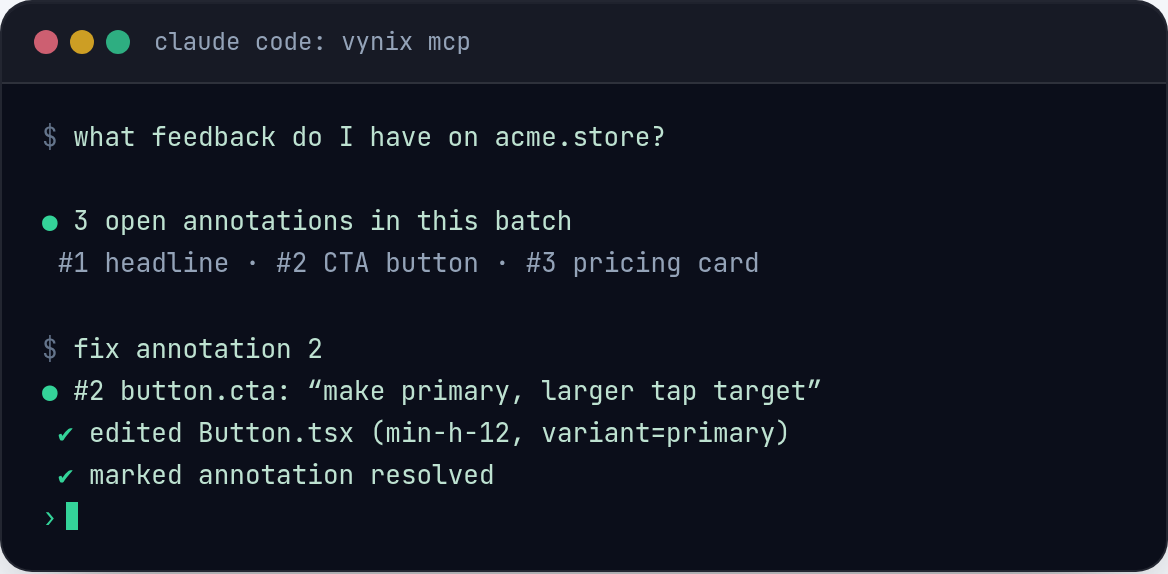
AI coding agents are much better when they start with the same evidence a developer would ask for in a bug report. The Vynix MCP server helps pass website annotation context to a compatible agent, so the agent is not guessing from a vague sentence like "the button is broken."
Why MCP is useful for frontend bug work
The Model Context Protocol, usually called MCP, gives AI tools a standard way to connect to outside context. Instead of pasting a long description into chat, you can give your agent access to structured information from another tool. For frontend work, that context matters because the visible symptom is often only a small part of the problem.
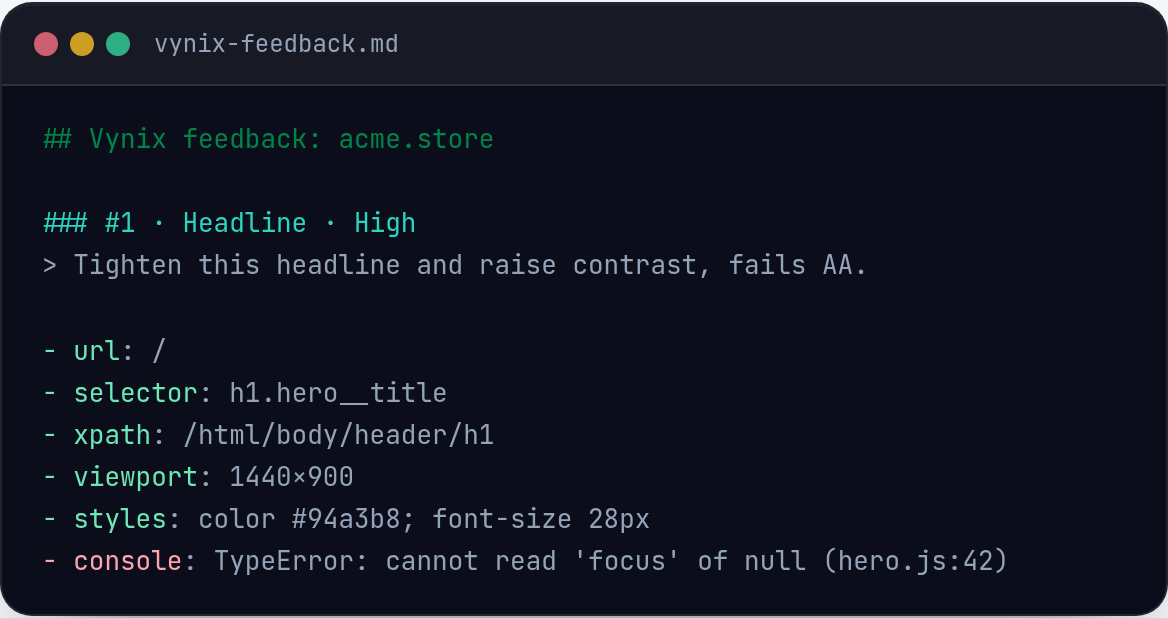
A broken checkout button, for example, could come from a disabled state that never resets, a JavaScript exception, a failed API request, a CSS overlay sitting on top of the button, or a feature flag returning the wrong value. If your agent only sees "checkout button does not work," it has to search too wide. If it sees the selected element, page screenshot, console errors, network context, and a diagnosis from Vynix, it can start much closer to the real issue.
The goal is not to let the agent blindly change code. The goal is to remove the low-value back and forth that usually happens before anyone can start fixing the bug.
- Less time spent asking for screenshots, logs, and reproduction details.
- Fewer agent responses based on assumptions.
- A clearer path from a website issue to a code change or GitHub issue.
What Vynix adds before the agent sees the issue
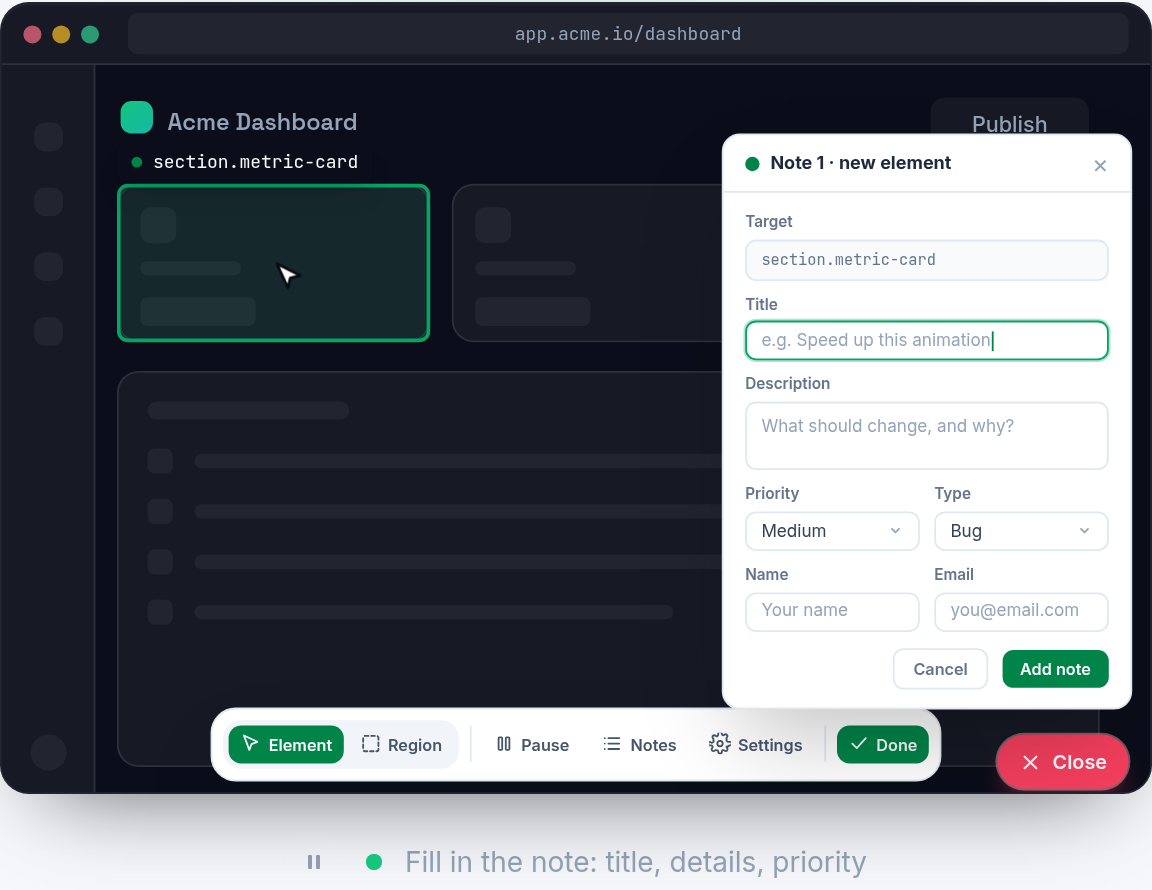
Vynix starts at the page where the problem happens. You drop a lightweight widget on the site, click on the thing that is wrong, and Vynix records the evidence around that click. That is a better starting point than a plain text report because the selected element and the browser state are tied to the exact moment of failure.
This is especially helpful for UI defects that are hard to describe. A tester might say, "the card layout is broken on the pricing page," but the useful details are more specific: which card, which viewport, which DOM element, what CSS class, whether a console error appeared, and whether a request failed just before the layout shifted.
- The page element the reporter clicked.
- A screenshot of the page state.
- Console context, such as JavaScript errors or warnings.
- Network context, such as failed or suspicious requests.
- An AI diagnosis of the likely root cause.
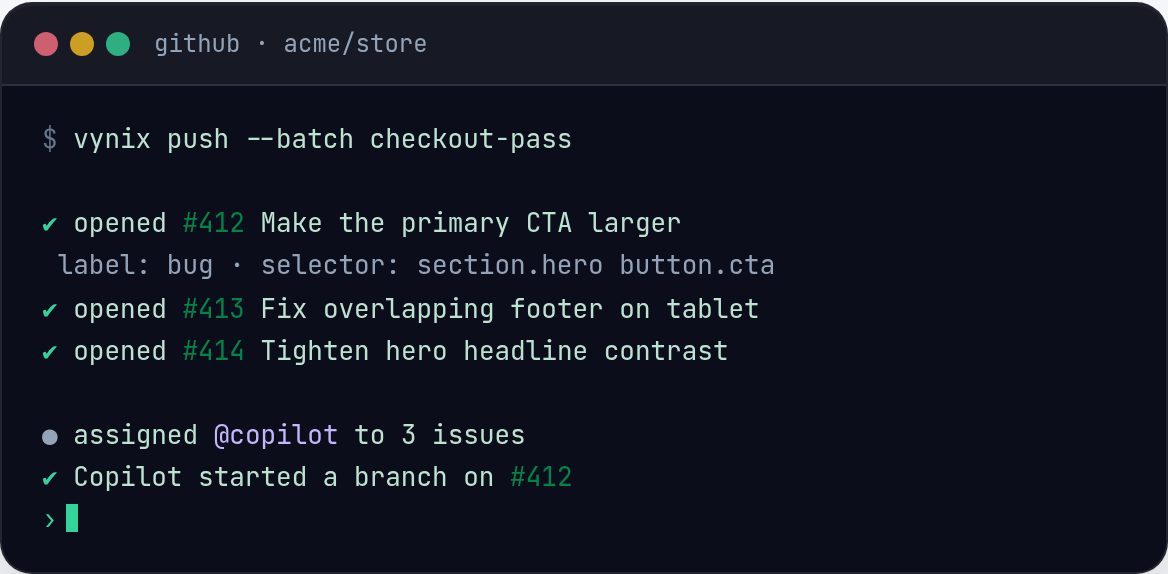
- A ready-to-build prompt or a GitHub issue that can be assigned to a coding agent.
A practical workflow with the Vynix MCP server
A good workflow is simple: capture the issue in Vynix, review the context, then pass it to the agent through the MCP server or through the prompt and issue flow that fits your team. The MCP server is useful when your agent supports MCP and you want it to pull the relevant Vynix context directly instead of relying on a copied block of text.
The exact setup depends on the AI agent and MCP client you use, so keep the configuration close to your team's normal development environment. What matters most is that the agent receives the Vynix evidence and that a human can still review the suggested plan before code changes are made.
- Add the Vynix widget to the site or environment where issues are being reviewed.
- Reproduce the bug and click the exact element or area that is wrong.
- Check the captured screenshot, console context, network context, and AI diagnosis.
- Use the Vynix MCP server from a compatible agent, or copy the ready-to-build prompt if that is how your agent is used.
- Ask the agent for a diagnosis and a small implementation plan before asking for code.
- Review the diff, run the relevant tests, and verify the fix in the browser.
What to ask your agent for
The first prompt should not be "fix this." That often produces a large, unfocused answer. A better request is to ask the agent to summarize the issue, identify the files it expects to inspect, and propose the smallest reasonable change. This gives you a checkpoint before the agent starts editing.
For example, if Vynix captured a failed POST request from a signup form and a console error that says a response field is undefined, ask the agent to trace the form submission path. It should inspect the client-side form handler, the API response handling, and the type or schema used for that response. If it jumps straight to restyling the form, the context was not used correctly.
A useful agent request can be short and direct: "Use the Vynix context for this issue. Explain the likely root cause, list the files you need to inspect, then propose a minimal fix. Do not change unrelated UI or refactor surrounding code." That sets boundaries without hiding the evidence.
- Ask for a root-cause summary before code changes.
- Ask which files or components are likely involved.
- Ask for the smallest fix that addresses the captured issue.
- Ask the agent to preserve existing behavior outside the reported path.
- Ask for test or verification steps you can run after the change.
Example: turning a bad bug report into useful agent context
Imagine a bug report that says, "Save button on profile page does nothing." On its own, that report is weak. It does not say whether the button is disabled, whether the click handler fires, whether the API request fails, or whether the UI saves but does not show confirmation.
With Vynix, the reporter opens the profile page, clicks the Save button, and captures the issue. Vynix records the selected button element, a screenshot of the profile form, console context, network context, and an AI diagnosis. The network context might show a failed request to the profile endpoint. The console context might show that the client expected "displayName" but the response contained a different shape. The screenshot shows that the form stayed open with no success message.
When the agent receives that context through the Vynix MCP server, the task becomes much narrower. Instead of hunting through the whole profile area, it can inspect the form submit handler, response parsing, and error display path. It can then suggest a focused fix, such as handling the actual response shape or showing the returned validation error. A human still needs to check the code, but the agent is now working from evidence instead of a guess.
Keep humans in the review loop
Vynix can collect better context, and an AI agent can turn that context into a plan or a patch, but the review step still matters. Frontend bugs often sit near product decisions: should an error be shown inline, should a button be disabled during loading, should a failed request retry, should the page keep unsaved input after an error? Those choices should not be left to an agent by default.
Use the agent for the mechanical parts: tracing code paths, finding the component, explaining the likely cause, writing a small patch, and listing verification steps. Keep a developer responsible for product behavior, security-sensitive changes, and the final merge decision.
This is also where GitHub issues can help. If your team prefers issue-based handoff, use Vynix to open an issue with the captured context and assign it to a coding agent when appropriate. The issue becomes a durable record of what was observed and what the agent was asked to fix.
- Review any suggested code before it is merged.
- Check that the fix matches the product behavior you want.
- Run tests and reproduce the original issue after the change.
- Avoid broad refactors unless the bug truly requires them.
- Keep the Vynix capture linked or included so future reviewers can see the original evidence.
- Vynix improves AI agent results by capturing the specific browser context around a website issue.
- The Vynix MCP server is most useful when your agent supports MCP and can work from structured issue context instead of a vague prompt.
- The best workflow keeps the agent focused on diagnosis and small fixes while a developer reviews behavior, tests, and the final code change.
Frequently asked questions
Do I need an AI agent to use Vynix?
No. Vynix is useful for capturing website issues on its own because it records the element, screenshot, console context, network context, and likely cause. An AI agent adds another step: it can use that context to draft a plan, propose a fix, or work from a GitHub issue.
What does the Vynix MCP server give to an agent?
It gives a compatible MCP-based agent a structured way to work with Vynix issue context. That can include the captured element, screenshot context, browser console and network information, and the AI diagnosis that Vynix generated for the issue.
Should I let the agent automatically merge fixes from Vynix issues?
Use caution. Vynix can give the agent better context, but a developer should still review the proposed change, confirm the intended behavior, run tests, and verify the fix in the browser before merging.
Install the widget with one script tag, point at a bug, and hand the fix to your coding agent.
Get started free