How Vynix cuts the cost of running AI coding agents
AI coding agents are only as useful as the context you give them. Vynix helps teams capture the exact browser evidence behind a website issue, then turn that context into a prompt or GitHub issue an agent can act on.
- Agent cost is often a context problem
- What agents usually miss from a normal bug report
- Vynix captures the browser evidence at the source
- Shorter prompts work when the evidence is specific
- Fewer reruns means less token spend and less review time
- From browser issue to build-ready task
- A practical workflow for lower-cost agent runs
Agent cost is often a context problem
When an AI coding agent gets a vague task, it has to guess. A ticket that says the checkout button is broken may sound simple, but it leaves out the page, the selected options, the browser state, the visible error, and the network request that failed. The agent may inspect the wrong component, edit the wrong file, or suggest a fix that only works for one path through the UI.
That guessing creates cost in two places. First, the agent burns tokens reading files, asking follow-up questions, and producing code that may not apply. Second, engineers spend time reviewing bad diffs, adding missing details, rerunning the agent, and checking whether the new attempt is any better. The money spent on the model is visible. The engineering time lost to trial and error is usually larger, even if it is harder to measure.
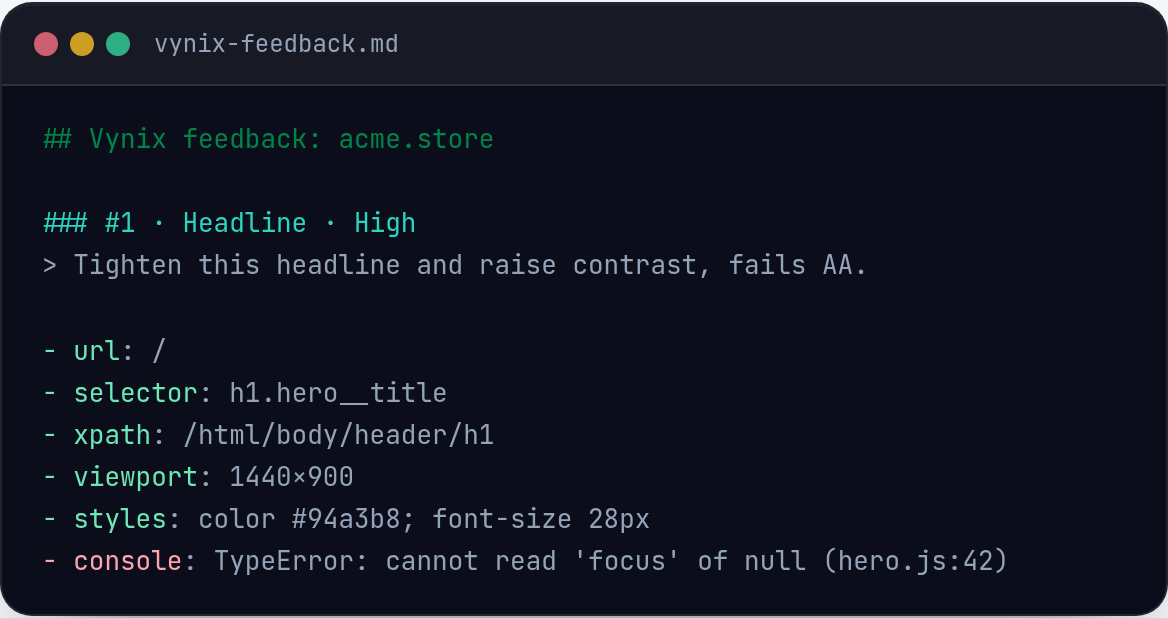
Vynix reduces that waste by changing the starting point. Instead of asking someone to describe a bug from memory, Vynix lets them click the broken element on the site. It captures the element, a screenshot, console and network context, page state, and an AI diagnosis of the likely root cause. That context gives the agent a narrower, clearer problem before it writes a line of code.
What agents usually miss from a normal bug report
Most bug reports were designed for humans. They contain a short title, a few notes, maybe a screenshot, and sometimes reproduction steps. A human developer can fill in gaps by asking the reporter questions, opening DevTools, and poking around the app. An agent can do some investigation too, but each extra step increases the chance it follows the wrong trail.
Website bugs are especially context-heavy. A visual issue may depend on a specific DOM node, a CSS rule, a viewport size, or a feature flag. A broken form may depend on a request payload, a 400 response, or a client-side validation error. A blank panel may be caused by an exception in the console that never appears in the UI.
A weak prompt usually misses details like these:
- Which exact element is wrong, not just which page has a problem
- What the user saw at the moment the issue was reported
- Relevant console errors or warnings
- Network calls that failed, stalled, or returned unexpected data
- The page state that made the issue appear
- A first-pass diagnosis that points the agent toward the likely layer
Vynix captures the browser evidence at the source
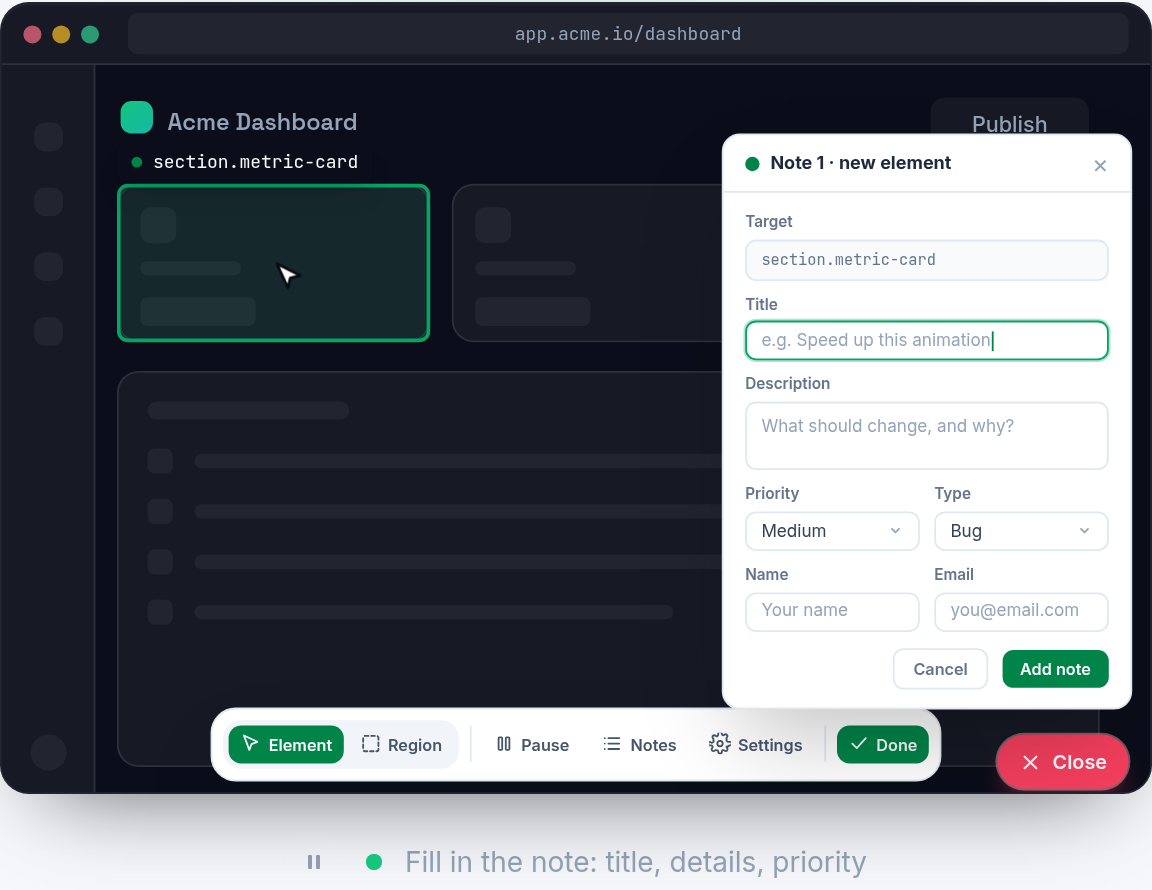
Vynix is built around the moment someone notices a website issue. You drop a lightweight widget on the site, then a user, tester, product manager, or engineer can click the thing that is wrong. That click matters because it anchors the report to a real element instead of a loose description.
From that action, Vynix captures the surrounding context an agent needs to reason about the bug. The screenshot shows what the user saw. The element capture identifies the part of the page involved. Console and network context expose errors and failed requests that may explain the behavior. The page state gives the task a concrete starting point. The AI diagnosis summarizes the likely root cause so the agent is not beginning with a blank page.
This does not mean the agent will always be right on the first try. It means the agent starts with the kind of evidence a careful engineer would collect before making changes. That difference is what cuts down on wasted runs.
- Element context helps the agent map the issue to the relevant component or markup
- Screenshots reduce ambiguity in visual and layout bugs
- Console context surfaces runtime errors the reporter may not notice
- Network context helps separate frontend bugs from API or data problems
- AI diagnosis gives the task an initial direction without pretending to be final proof
Shorter prompts work when the evidence is specific
Long prompts are often a symptom of missing evidence. Someone tries to compensate for uncertainty by writing paragraphs of background, guesses, and warnings. The prompt may include old reproduction notes, unrelated product context, and instructions to check many possible causes. Agents can handle long prompts, but longer does not always mean better. It can dilute the important facts and increase token use.
With Vynix, the prompt can be shorter because the context is structured around the actual issue. Instead of writing, please investigate why users sometimes cannot submit the billing form, the task can point to the captured element, the visible page state, the console error, the failing network request, and the AI diagnosis. The agent receives fewer vague instructions and more relevant evidence.
A tighter prompt also makes the result easier to review. If the report includes a failed request and the agent changes unrelated styling, that mismatch is easy to spot. If the screenshot shows a disabled button and the agent updates an API client, the reviewer can ask why. Specific inputs make poor outputs more obvious, which helps teams stop bad runs earlier.
Fewer reruns means less token spend and less review time
The expensive part of AI-assisted development is not only the first run. It is the loop. A weak first prompt produces a weak patch. An engineer reads it, realizes the agent misunderstood the bug, adds more detail, and runs it again. The agent reads the repo again, generates another answer, and may still miss the point. Each pass consumes model tokens and attention.
Better front-loaded context changes the loop. If the agent begins with the element, screenshot, console context, network context, page state, and diagnosis, it has fewer reasons to explore unrelated files or invent missing facts. It can focus on the likely component, the observed error path, and the code that handles that state. The prompt becomes less about exploration and more about implementation.
That lowers cost without relying on a magic formula. You do not need to claim a fixed savings percentage to see the pattern. Fewer wasted agent runs mean fewer tokens spent on irrelevant investigation. Clearer tasks mean less engineer time spent rewriting prompts. Better evidence means less back-and-forth between QA, product, and engineering.
- Less repeated repository scanning for the same issue
- Fewer follow-up prompts to add missing browser details
- Less time spent reviewing patches based on wrong assumptions
- Faster triage because console and network clues are already attached
- Cleaner handoff from bug report to agent task
From browser issue to build-ready task
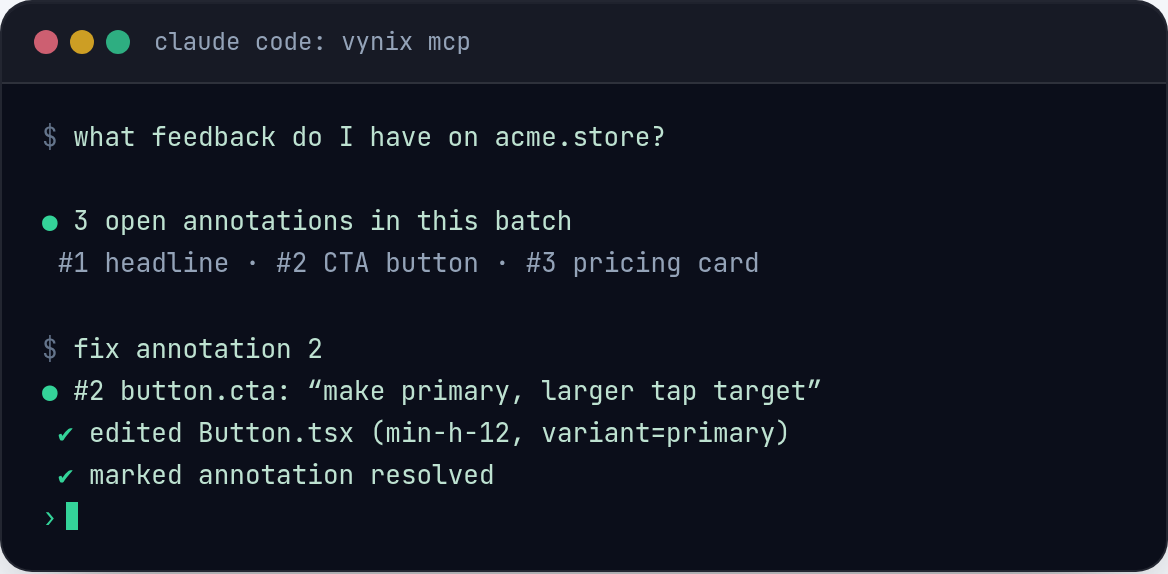
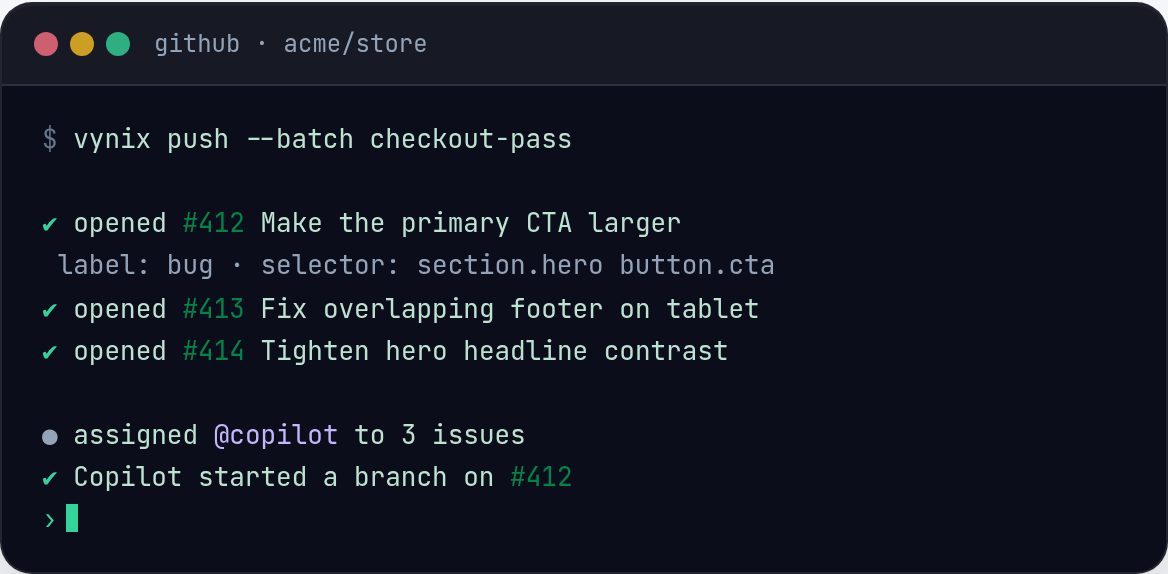
Capturing context is only useful if it reaches the place where work happens. Vynix lets you copy a ready-to-build prompt or open a GitHub issue and assign it to a coding agent. That keeps the browser evidence attached to the implementation task instead of leaving it in a chat thread, a screen recording, or someone's memory.
For example, imagine a product manager finds that clicking Apply coupon shows no message and does not update the total. With a normal report, an agent may search for coupon UI code, form handling, validation messages, and pricing logic. With Vynix, the task can include the selected button or field, the screenshot, the console output, and the network call that returned an error or unexpected response. The agent can start by checking the code path tied to that evidence.
The same pattern helps with visual regressions. If a card layout breaks only when a certain panel is open, the captured page state and element context give the agent a concrete target. The prompt does not need to describe the whole app layout. It can point to the captured element and ask for a fix that preserves the state shown in the screenshot.
A practical workflow for lower-cost agent runs
The goal is not to replace judgment. The goal is to stop paying agents to rediscover facts the browser already knows. A practical workflow starts by capturing the issue at the point of failure, then passing that context into the agent task before any code is generated.
Teams can use Vynix as the front door for website bugs that may go to an AI coding agent. Instead of asking reporters to write perfect reproduction steps, ask them to click the broken element with Vynix. Review the captured context, copy the generated prompt or open the GitHub issue, then assign it to the agent with the evidence intact. Engineers can still inspect the output, run tests, and decide whether the diagnosis was correct.
This workflow is simple, but it removes a common source of waste. The agent gets a better starting point. The engineer gets a clearer review target. The team spends less time translating browser problems into development tasks.
- Capture the issue in the browser when it is visible
- Keep element, screenshot, console, network, and page state together
- Use the AI diagnosis as a guide, not as unquestioned truth
- Send the agent a focused prompt or GitHub issue
- Review the code against the captured evidence before merging
- AI coding agents waste tokens and engineer time when bug reports are vague.
- Vynix captures the browser context an agent needs, including the element, screenshot, console, network, page state, and AI diagnosis.
- Better context up front leads to shorter prompts, fewer reruns, and less trial and error.
Frequently asked questions
Does Vynix replace an engineer reviewing agent output?
No. Vynix improves the input to the agent by capturing browser context and producing a useful starting prompt or GitHub issue. Engineers should still review the code, run tests, and confirm the fix matches the captured issue.
Why does element-level context matter for AI coding agents?
Element-level context tells the agent exactly what part of the page is involved. That can help it focus on the relevant component, markup, styling, or event handler instead of searching the whole app from a vague description.
How does Vynix lower the cost of using agents?
Vynix lowers cost by reducing wasted work. When the agent gets the element, screenshot, console and network context, page state, and an AI diagnosis up front, it needs fewer exploratory runs and less back-and-forth from engineers.
Install the widget with one script tag, point at a bug, and hand the fix to your coding agent.
Get started free