Using review rounds to group feedback into fixes
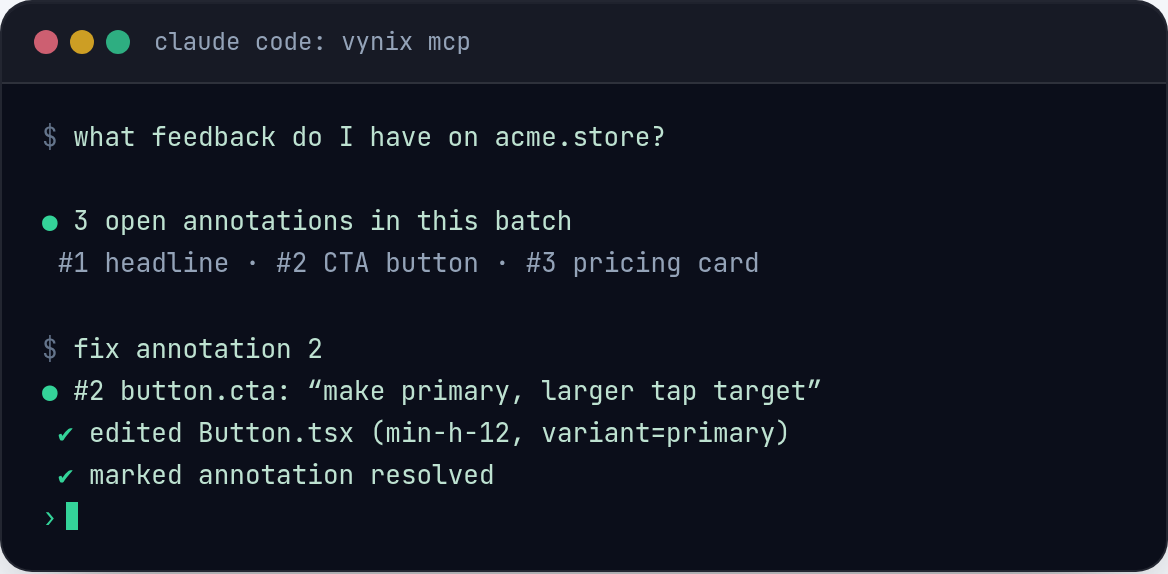
Review rounds in Vynix help you collect related website feedback in one focused pass. Use them to turn scattered annotations into a clear set of fixes for a developer or coding agent.
- Start a new review round before you begin checking a page, flow, or release.
- Click the widget on anything that looks wrong, such as layout issues, broken states, copy problems, or console errors.
- Add a short note for each annotation so the issue is easy to understand later.
- Review the captured context, including the element, screenshot, console and network details, and AI diagnosis.
- Group the round into fixes by copying a ready-to-build prompt or opening GitHub issues for the items that need work.
A review round is a way to organize feedback from a specific review session. Instead of collecting annotations as separate, unrelated comments, a round keeps them tied to the same page check, QA pass, design review, or release review.
Each annotation in a round includes developer context that helps explain the problem. Vynix captures the selected element, a screenshot, console and network context, and an AI diagnosis of the likely root cause. This makes it easier to move from feedback to an actionable fix.
Review rounds are useful when you want to separate feedback by feature, sprint, reviewer, or release. For example, you might create one round for a checkout flow review and another for a homepage polish pass.
After the round is complete, use the collected context to create implementation-ready work. You can copy prompts for a developer or coding agent, or open GitHub issues and assign the work from there. For exact setup details, see the Vynix docs.
Related questions
What are review rounds in Vynix?
Review rounds are organized review sessions that group related annotations and feedback together. They help teams collect issues from a specific page, flow, feature, or release and turn them into clear fixes.
When should I create a new review round?
Create a new round when the context changes, such as a new feature, release, sprint, page, or QA pass. This keeps feedback easier to review, assign, and resolve.
Read the full documentation or email hello@vynix.in.